Quote on cash flow.

Quote

Slide1

My Dad was a very good businessman in LaPorte, IN and always knew the value of cash flow into his company.  Today in his 80s he manages his & mom’s money as well as anyone I have ever known.  Our CFO at Solution Tree & MRL constantly reminds us that “Cash Is King”.  And he is right.  We need to have cash (cash flow) to keep the day to day operations running.  Funny thing how people get attached to those paychecks!

But how important is cash flow?  Well…..

Cash is more important than oxygen.  You can buy oxygen.


Slide1

Our Mission Statement

When we bought the company in 1998 it had the same three basic revenue streams we have today:

  1. Shipable items:  Books, DVDs, Pin #s, etc.
  2. Contract work:  Professional Development dates, be it one day, long-term or video
  3. Registration events:  Workshops, Institutes, Summits

Obviously the company looks drastically different from what it did fifteen years ago, but maybe the single greatest change we implemented was our Mission Statement.  When we started we didn’t have a viable mission statement, vision statement, set of core values, common goals, guiding principles or focused strategies for the company.  It wasn’t until 2004 that we actually figured out who we really were, wanted to be, and were able to articulate and embed throughout the entire company.

A vision statement to me is ‘why’ we do what we do.  A mission statement is ‘how’ we do it.  And the resources we create and produce are ‘what’ we do.  I will write about the Vision next week, but today is all about the ‘How’.

To advance the work of our authors.

That is it. That is our mission statement.  I know your first thought was probably.  “Wow, that took you 6 years to figure out.  Phew…slow on the uptake there Jeff.”  And you maybe right, but this Mission Statement is a bit deeper than at first blush.  Let me dissect this simple statement.

To Advance:  We create and use whatever ‘means’ possible to get the Intellectual Property (IP) of our authors into the hands of those educators who are looking for solutions to a particular problem or need.

the Work:  Our job is to get the work, the resources, into the hands of those educators.  This is not about making rock stars, though that has been an unintended consequence for many of the authors, but our focus is on their ‘work’.

of Our Authors:  We do not promote the work of an author we do not publish.  If we publish an author’s work, we do not promote the work he/she has produced earlier with another publisher. We do not hire consultants whom we have not been the publisher of their work.  We do not contract presenter at our events unless they are our author, or that they are an Associate of our Author who will be representing our author’s work.

We are loyal and committed to our authors.  We take great pride in the experts we have published and are quick to sing their praises, but again, it is not about them it is about their work.  And we give their work our undivided attention.

As my good friend Bill Ferriter, author of some outstanding books through Solution Tree and a GREAT Blog, Tempered Radical, summarized to me after a dinner in Australia where we were discussing Solution Tree, blogs, tech tools, and raising kids,

So your primary goal is to identify people whose ideas hold the potential to improve schools on behalf of kids, so ‘advancing their work’ means ‘improving schools by giving a platform to the ideas that matter the most’. Not advancing ideas that you hope are going to make you some cash.” 

BINGO!  I hope someday that I can write half as well as he does.  Cash is good, in fact I plan to write about Cash Flow in a couple of weeks in a ‘Quotes Blog’, but it is not about cash.  It really isn’t.  Sure I want to live a nice life and provide for my family, and I want to offer a good secure job and fair salary to all the people at Solution Tree, but it can never be about profits, it has to be about people.  The people are educators, authors, staff, etc.  If you focus on the profits you will lose the people, if you focus on the people the profits will follow.  I’ll blog more about that someday soon.

To advance the work of our authors.  That is ‘how’ we do what we do.

From Rome to Chicago…not really a great route.

We have all heard the phrase “Rome wasn’t built-in a day”.  According to my good friend Wikipedia, this phrase is an English translation of a medieval French phrase, and was published by John Heywood in 1538 in A Dialogue Conteinyng the Nomber in Effect of all the Prouerbes in the Englishe Tongue and then Queen Elizabeth referred to the idea in an address at Cambridge in 1563.  Who knew!?!?!?

To us it is used when reminding someone that a particular task or goal takes a long time to complete properly, and that great things take time and diligence to create.  Such as the Great Ancient City of Rome.

In it’s hay day, the 1st Century, Rome was something to behold.  The center of a great empire with an estimated 50 to 90 million inhabitants (roughly 20% of the world’s population) and covering 2.5 million square miles. The remains of many structures still stand some 2000 years later, and today Rome is the 3rd most visited city in Europe, following London and Paris, with an avearge of 7-10 million tourist each year.

Slide1

Now jump forward in time to 1871 and across the big pond to Chicago, IL.  Chicago was a bustling community of trade and commerce on the Great Lakes. Chicago was also the home of a new baseball team called the Chicago White Stocking, who would change their name three times before settling with the name Chicago Cubs.  The White Stocking won the League Championship that year, something the Cubs rarely do….but I digress.

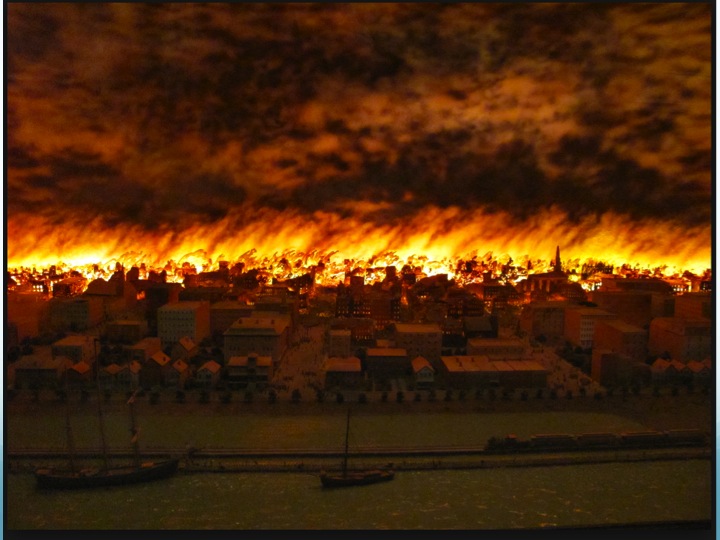
Now the story is told that on Sunday October 8, 1871 a cow kicked over a lantern in the barn owned by Patrick and Catherine O’Leary.  The fire began about 9:00 p.m. and by midnight it had jumped the river’s south branch, and by 1:30 a.m. the business district was in flames. Shortly thereafter the fire raced northward across the main river. With limited firefighting equipment, the city’s fire department was helpless as the flames jumped from building to building…

Slide1

.                               …and Chicago burned overnight.


Rome wasn’t built in a day, but Chicago burned overnight.

Just think about that for a moment.  Everything that someone can build here on earth over a lifetime, be it physical structures, a career, a reputation, relationships, a family, wealth, belongings, anything, can all go up in smoke overnight. It just takes one bad or impaired decision, a lie, an indiscretion,  a distraction while driving, a stupid move, or just a stroke of bad luck.

There are some great examples in our life times of famous people whom all fell into this category.  Such as Bill Clinton’s Presidency, Howard Cosell’s broadcasting career, those who invested in Bernie Madoff’s company, Scott Peterson & OJ Simpson, Lance Armstrong & A-Rod, etc.  Our jails, news papers and tabloid magazines are full of people who let their Chicago burn down one night.

We all personally know someone who fits this bill.  And we are all guilty to this ourselves in various degrees.  I personally have not burned down whole villages, but there is more than one scorched building in my past, and a couple of big ones.  Knowing what caused the fire, being accountable and prepared to pay for the damages, and setting up systems never to repeat the situation, is how we move forward to rebuilding our Chicagos.  Today the city of Chicago is a world commerce center, and a great place to live and visit.

My advise to my kids, and to myself…don’t play with matches, you will eventually get burned.


At-A-Boy!

It may actually be That-A-Boy, not sure.

Do you ever wake up in the wee hours of the morning with a ‘Work-mare’?  You know, that problem or project at work that has you stressed, has you tossing and turning, has you anxious about a To-Do, a project due, or something you forgot. I am a regular in this category.  I probably wake up around 2:30-3:00am with work on my mind 3 to 4 times a week. Today’s ‘Work-mare’ was…oh man, yesterday was Thursday and I didn’t post a blog like I committed I would a couple weeks ago.  DANG IT!

So then I tossed and turned and rolled and thought, what do I write?  Will anyone notice I failed on my commitment?  Will everyone notice I failed on my commitment?  Should I say how busy I was?   That I traveled this week, had family and friend in last night for a dinner sending my son off to school?  What if I wake up Margaret again at 3:00 in the morning, is she going to kill me this time?   And, this is not gonna get me one of those At-A-Boys my good friend Doug Reeves was talking about last week when we were meeting in Boston.  That’s it!!! At-A-Boys!!!!!  Back to sleep.

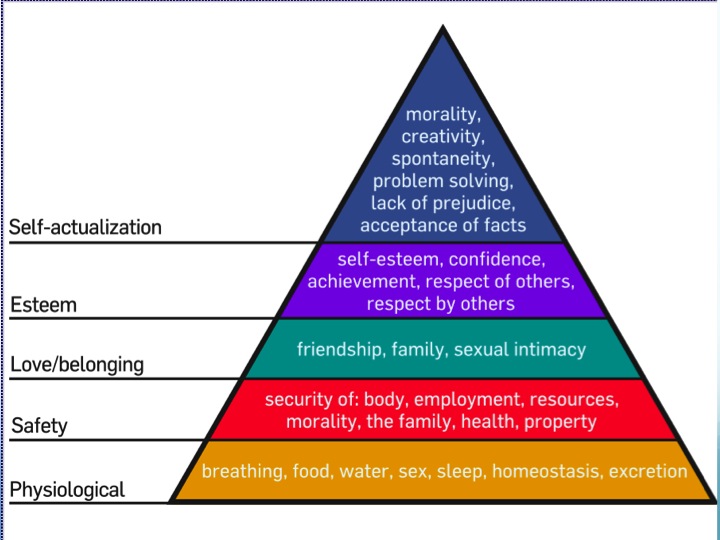
Doug challenged me to hand out 5 At-A-Boys a day.  Not necessarily to any one specific group, but just give ’em out.  Staff, friends, family, associates, or strangers…animals don’t count.  So I put it to practice.  I decided to leave my kids out of the count as my wife and I spend more time encouraging than correcting, they are really great kids and we tell them they are great regularly.  An At-A-Boy, which my mother-in-law would call a BRAVO,  takes only a few seconds but can have a long and huge impact on someone’s demeanor at that point in their day.  It validates the effort they have put into something, and Maslow concludes it is pretty darn important.  And that Mr. Abraham Maslow guy is way up there on my RSG List (Really Smart Guy).

Slide1I know I FAILED at my commitment of being on-time with this Thursday’s post, and I promise to do better, but I haven’t failed on my 5 At-A-Boys per day goal, and I don’t plan to stop at 5.  When sincere, they are really fun to hand out, they are greatly appreciated, and it makes me think about how hard the person I am At-A-Boying is really working to be successful.  My appreciation for others is truly increasing.

So go ahead, because it’s like that old Alka Seltzer TV commercial. “Try it, you’ll like it!”

Okay quote on Tuesday is one I coined, and Post on Thursday is about Solution Tree’s Mission Statement.  Until then, thanks for reading, and At-A-Boy Doug, great suggestion!

Tuesday quote by John Gardner (sorry original post had wrong Gardner quoted)

So for the 14th year in a row, I am very fortunate to be sitting in Rick DuFour’s keynote at our PLC Institute in Lincolnshire.  I have heard Rick keynote many times and in many venues over our 16 year partnership of providing GREAT materials and institutes on Professional Learning Communities (PLC).  But I have to say, I love the keynote he is doing this year, LEADERS WANTED:  How Leaders at ALL Levels Can Support the PLC at Work Process.

Besides being a very good friend, Rick is a true professional when it comes to writing and presenting.  He reads and reads and reads, takes notes on others work, compiles his research and combines that with his own practical experience and knowledge and presents a compelling case, citing all of the content where appropriate.  His messages are captivating and spot-on for his audience.  Really one of the best presenters and teachers I have ever known.

One quote Rick referenced today was from John Gardner, former President of the Carnegie Foundation, Secretary of Health Education and Welfare under Lyndon Johnson, and founder of Common Cause

“Every great leader is teaching, and every great teacher is leading.”

John W. Gardner

Pretty simple, but think for  a moment of all the people you lead each and every day.  Children, friends, staff, peers, athletic teams, church groups, you name it, you are involved and connected to others. We are all involved in groups of people, or teams of people, and at some point we are leading them in a certain direction.  But do we realize we are teaching at the same time?  By leading we are teaching.

So now jump to the ladder half of this quote, where Mr. Gardner states that a leader is a teacher.  You may be teaching a skill like riding a bike, how to use an app on a smartphone, how to hit a serve on the tennis court, or you’re on a project team at work, a book study, a parent group, etc. etc. etc.  Be it small or large, fact or opinion, when you share you are teaching.

So what is the point?  Well one point is that when we teach, other learn, so we better know what we are teaching and the direction we are leading them.  But the second, and much more important point, is that our school teachers are leading a generation of students.  The people who will lead our world and teach the next generation.  A massively important and very, very hard job if done right.

If anyone is watching you, believing what you say, and following you, then you are leading.  Better make certain you know where you are taking someone.

And if you can…go thank a teacher today.  Creating future leaders is why they do it.

AAR

In my post Greatest Evaluation Ever I mentioned that we did After Action Reviews (AAR) on each session, each day and the overall event.  We also use evaluations from our participants from each and every breakout and keynote to help the presenters improve, as well as to help us craft and create a better even each and every time we hold one.  One of our five Core Values at Solution Tree is ‘dedication to quality’, and one of our four Guiding Principals is that ‘we are a continuous learning organization’.  We work SO hard to live up to our Mission-Vision-Values-Goals, and these are maybe two of the most critical.

An AAR is a fantastic way to look back at any activity, preform an assessment and improve upon it the next time around.  Here are what I consider the five critical step in anyone’s AAR.  You can make it more complex, but you can’t make it any simpler.

  1. Describe the experience you’d like to improve and learn from.
  2. What worked?
  3. What didn’t work?
  4. If you could do this experience over-knowing what you know now-what would you do differently?
  5. What action steps and systems must you implement to create the experience you want next time.

Just this week I was told by an educator, whom I can’t name because I do not have permission, that their district is only allowed to go to Solution Tree events. Reason being is that great content, high quality experience and implementable walk-away action steps are guaranteed, and Solution Tree events are the best in the business.  Now this person may be blowing smoke…but it sounded right to me!

As for AARs, they are not for everyone…just those who want to get better and better and better and better!  That’s why we do it.


Share a Quote

Okay, so I am still a newbie at this blogging stuff, but heck I’m havin fun and if both of you keep reading, I’ll keep writing.  :  )

I have to admit I just LOST this entire post due to operator error, and am re-crafting this blog with less zeal this time around.  Dang it!  Anyone relate here?

On my July 17th post I said I would commit to posting to my blog each Thursday.  Now here is a new commitment.  Each Tuesday, until I come up with a better idea, I will post one of my favorite quotes and share my opinion/insights on the quote, how it relates to my life, Solution Tree and MRL, life in ‘education’, you and me, etc.

I just finished dinner at the Boston Copley Marriott Concierge’s  Lounge, eating free food (not), drinking an expensive glass of wine (not worth the price), and reading the latest edition of FORBES Magazine.  This is a quote that struck me as a bit different, but it also is what gave me the ‘Share a Quote’ idea.

So here we go.

The definition of a pioneer is a guy with his face in the mud and an arrow in his back.   If we haven’t thought (of) it, and it’s working, then we’ll copy it and try to make it even better.  There’s no shame in it.”

Bill Marriott

I personally buy into the CASE theory (Copy And Steal Everything) as long as it is not plagiarism or just plain wrong.  But, we all need to be our own judges here, and listening to our conscience.

P.s. I did write this Tuesday, but another operator error caused it not to go out until Wednesday….dang it.

Vacation sanity

This week I have been on vacation with my family in VT.

IMG_5692

Mountain biking at Von Trapp Family Lodge

One of the balances I always struggle with is work while on vacation. I know that many people just shut down all together, put on an auto-reply and disconnect. I tried that once for four days a couple of years ago, leaving my laptop and cell phone behind.  It took me at least half a day to clear my head, and I reached for my phone a dozen times within the first two hours.  My wife got an emergency phone call from my office about a medical issue with of our key leaders, and then somewhere in the middle of the fourth day my brain kicked into work mode and all the things that awaited me upon return.  Can’t say I got the full four days out of disconnect, but the wow was the e-mails that awaited. Ouch.

So this week I tried a new approach.  I have chosen to get up early, do work until 11:00 then shut down for the rest of the day. Heck with three teenagers and an eleven year old I usually have to wake up a couple of them at 11:00 to get their days rolling.

The system seems to have worked great.  Low stress of thinking about work, lots of family time, and my emails are way under control.  I feel connected yet certainly feel engaged with the whole family.  But this is my system, and it may work for you, but you have to find your own. The family deserves to have their time.

I consider our work at Solution Tree and MRL too important…and fun…to not be connected.  I like work, and heck it is my vacation too!


It all starts with a book!!!

To advance the work of our Authors.  This is our mission statement and we LIVE BY IT. So to work with us you need to be an author and you need to be our author.  So  how does one become an author and why are our authors’ books constantly receiving national awards?  Well here is the process led by Mr. Douglas Rife, President Solution Tree Press, and outlined by Ms. Kari Gillesse, Associate Acquisitions Editor.

When many people pick up a book, they see only the finished product: A beautiful glossy cover and chapters bound together. But the cover and binding are just one part of the process of how an idea becomes a book. Here’s how it works at Solution Tree.

Good books begin with good ideas, and the point at which authors send those ideas to us varies. Sometimes, authors come to us with a general overview of the idea for their book, and so we’ll ask them to start writing and submit a few sample chapters to us so we can get a better feel of the content. Other times, authors have a complete draft of their book ready to share with us. And finally, sometimes we approach authors to write for us if we are familiar with their work and we like what we’ve read and/or heard. Such books often grow out of conference presentations, journal articles, and even conversations we have had with the author. On average, we receive about 55 unsolicited manuscripts a year (mostly sent to us through the “Publish With Us” section of our website), and we solicit about 35 from authors with whom we have current connections or made contact. Of all submissions, we publish 30-35 books a year.

Whether a manuscript is unsolicited (authors bring their manuscript to us without any prior invitation from us) or solicited (we approach the author to write for us), we want to make sure that the manuscript is research-based with practical strategies for K-12 educators. In other words, we want to be sure that the content aligns with the type of book we publish and fits with our mission, vision, and goals. At this point, unsolicited manuscripts that do not fit this criteria are rejected, and authors of solicited manuscripts are given another chance to rewrite and resubmit.

We then send the draft out for double-blind peer reviews by other educational professionals in the field for whom the manuscript would be appropriate. Since neither the author nor the reviewers know the identity of each other, this process gives us honest feedback about the manuscript’s strengths and weaknesses. When the reviews are in, Douglas Rife and I measure reviewers’ feedback with our own perceptions of the manuscript’s ability to fit into Solution Tree’s publishing niche. If we (and the majority of reviewers) think the manuscript has merit and can make a worthy contribution to the field, we present the manuscript to the editorial board, who then votes to determine whether Solution Tree will publish it or reject it.

Following the editorial board’s approval, we issue a contract to the author for his or her manuscript. The author’s complete manuscript will be sent out for an additional round of peer reviews, and then we send the feedback and editorial suggestions to the author. The author submits a revised draft to us, and then it is transmitted to production, where the manuscript will undergo more editing and revisions, copyediting, reference checks, permissions assessments, and formatting. Our designers will create a beautiful cover and our team will write marketing copy for the book at this point, too. Once these steps are complete, the book is sent to the printer, where it will be bound and shipped to our warehouses. From the point the manuscript is transmitted to the point where it is shipped to our warehouse as a finished book, the process takes about seven months.

Getting a manuscript published is a competitive process, but a rewarding one, too. It’s amazing to see the work of our authors making a real difference in so many students’ and teachers’ lives around the world.

Ultimate Cliffs Notes

Okay, I have to be honest, my degree is in business not education, and before Solution Tree I spent 14 years in higher education administration not K-12 public education.  So, some might say when I began to run Solution Tree I did not have a solid understanding of the K-12 market.  Some might be right. 


I quickly hired a consultant, drew from my non-profit background, went to a lot of conferences, read as many trade publications as I could fit in, but still felt woefully uninformed.


Oh how do I wish I knew ‘then’ what I know now.  And the ‘then’ is the newsletter Marshall Memo.


Okay this next part I copied from his website, but I know it all to be true. 

Note: I am not getting paid to share this information, and I have never met Kim Marshall. I did have to email him once to apologize after I promoted his newsletter to 2,000 people at one of our events and he was unexpectedly swamped with free issue requests.  Not nice.

Kim Marshall

      Kim Marshall

The Marshall Memo, published since 2004, is designed to keep principals, teachers, superintendents and others very well-informed on current research and best practices in  the field.  Kim Marshall, drawing on his experience as a teacher, principal, central office administrator, consultant, and writer, lightens the load of busy educators by serving as their “designated reader.”

To produce the Marshall memo, Kim subscribes to 64 carefully-chosen publications and looks through score of articles each week to select 5-10 that have the greatest potential to improve teaching, leadership, and learning.  He then writes a brief summary of each article, provides e-links to full articles when available, highlights a few striking quotes, and e-mails the Memo to subscribers every Monday (with the exception of a one-week break at Christmas and a two week mid-summer vacation).

Kim Marshall rocks, and the newsletter is well worth the price of subscription.  We can all learn a lot from the Memo on how to help educators…and that is why we do it.