Being Lucky

Having been in the event business now for 17 years, I have to say we have an unbelievable track record of never having a keynoter miss an event due to illness or travel.  On a very rare occasion we will have a breakout presenter miss an event due to unforeseen circumstances, mostly travel related, but for the most part it has been remarkably minimal.  Coming up on 1,000 Summits, Institutes and workshops you might say we are one lucky company, and we are, but not lucky the way you might be thinking.

We are blessed to have the presenters we have.  The quality of individuals who tirelessly present to educators ranging from eager to skeptical, and intense to apathetic, is unprecedented in our field.  Their job is no easy task, but WOW are they professionals and do they every care.

Let me give you a recent example of just how dedicated these experts truly are, and believe me they are not alone.  This is not an isolated case. This happened at our very last Summer Institute held August 13-15.

Rick and Becky DuFour spent 16 hours getting to Grand Rapids from Roanoke, VA.  One cancelled flight, one flight delayed two hours, another delayed 30 minutes,

and finally getting to the hotel at 12:15am with Becky kicking off the Institute with an 8:00am keynote in front of 1,000 in-house educators.

Tim Brown had his flight cancelled in Moline so he rented a car and drove six hours so he could arrive in Grand Rapids at 2:00am, and he is not only a presenter but also the emcee kicking off the event and introducing Becky.  And then he had tells me “I got to drive through some beautiful countryside on my six hour road trip.”  And he meant it, and by my calculations it was dark for nearly 5 of those hours.

Jack Balderman has a flight cancelled and drove from Midway Airport in Chicago to Grand Rapids arriving at 4:00am.

And Anthony Muhammad had a flight diverted from Phoenix to Yuma, only be bussed two hours back to Phoenix, to have another flight cancelled, and then hopping on a red-eye to Detroit and then driving to Grand Rapids to get to the Institute at 9:30am.

Are we lucky, you bet your bottom we are. We are lucky to work with people like these people, and we work with more than just these five examples.  We work with hundreds of pros just like these.  And that is why we do what we do.

Okay, a shamless way to end my blogging lapse.

So…I have been sooooo bad about blogging lately.  Lots of really bad reasons I won’t share or make up, so let’s begin again.

Too often I think, “Why in the world would anybody care about what I feel like pontificating about?”  Heck my own wife doesn’t read this blog. And as for my kids (16, 15, 13, 12), I am happy they still like me.  Though I am entering into a flash mob phase of ‘my parents are dorks’, so why set myself up for them telling me I have business all wrong.  Any ways…I do have about a dozen topics I am going to write about over next few weeks.  Then tonight, while sitting our rental in Culver, IN, after watching our 15 year old play lacrosse for his Boarding School (lots to share there…oy vey) I received this email from one of our Associate/Authors, Tom Hierck.  Really nice guy who is writing a book for Solution Tree with one of my favorite human beings, Ken Williams.  Ken and I share a thing for good watches and classic Lincolns.  I’ll write about my ’65 convertible some day soon.  Their book is going to be great, but I promise not to kick into sales mode here.

“Why” is a big deal to me. But you knew that.  Here is another indicator as to why Why is a big deal in schools, and really in all that we are or want to be.  Thanks Tom and Ken.


Tom Hierck                      Ken Williams


At-A-Boy!

It may actually be That-A-Boy, not sure.

Do you ever wake up in the wee hours of the morning with a ‘Work-mare’?  You know, that problem or project at work that has you stressed, has you tossing and turning, has you anxious about a To-Do, a project due, or something you forgot. I am a regular in this category.  I probably wake up around 2:30-3:00am with work on my mind 3 to 4 times a week. Today’s ‘Work-mare’ was…oh man, yesterday was Thursday and I didn’t post a blog like I committed I would a couple weeks ago.  DANG IT!

So then I tossed and turned and rolled and thought, what do I write?  Will anyone notice I failed on my commitment?  Will everyone notice I failed on my commitment?  Should I say how busy I was?   That I traveled this week, had family and friend in last night for a dinner sending my son off to school?  What if I wake up Margaret again at 3:00 in the morning, is she going to kill me this time?   And, this is not gonna get me one of those At-A-Boys my good friend Doug Reeves was talking about last week when we were meeting in Boston.  That’s it!!! At-A-Boys!!!!!  Back to sleep.

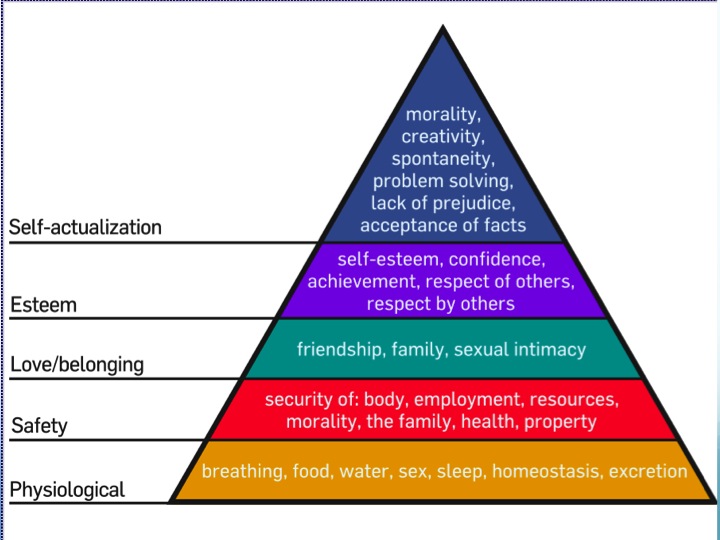
Doug challenged me to hand out 5 At-A-Boys a day.  Not necessarily to any one specific group, but just give ’em out.  Staff, friends, family, associates, or strangers…animals don’t count.  So I put it to practice.  I decided to leave my kids out of the count as my wife and I spend more time encouraging than correcting, they are really great kids and we tell them they are great regularly.  An At-A-Boy, which my mother-in-law would call a BRAVO,  takes only a few seconds but can have a long and huge impact on someone’s demeanor at that point in their day.  It validates the effort they have put into something, and Maslow concludes it is pretty darn important.  And that Mr. Abraham Maslow guy is way up there on my RSG List (Really Smart Guy).

Slide1I know I FAILED at my commitment of being on-time with this Thursday’s post, and I promise to do better, but I haven’t failed on my 5 At-A-Boys per day goal, and I don’t plan to stop at 5.  When sincere, they are really fun to hand out, they are greatly appreciated, and it makes me think about how hard the person I am At-A-Boying is really working to be successful.  My appreciation for others is truly increasing.

So go ahead, because it’s like that old Alka Seltzer TV commercial. “Try it, you’ll like it!”

Okay quote on Tuesday is one I coined, and Post on Thursday is about Solution Tree’s Mission Statement.  Until then, thanks for reading, and At-A-Boy Doug, great suggestion!

It all starts with a book!!!

To advance the work of our Authors.  This is our mission statement and we LIVE BY IT. So to work with us you need to be an author and you need to be our author.  So  how does one become an author and why are our authors’ books constantly receiving national awards?  Well here is the process led by Mr. Douglas Rife, President Solution Tree Press, and outlined by Ms. Kari Gillesse, Associate Acquisitions Editor.

When many people pick up a book, they see only the finished product: A beautiful glossy cover and chapters bound together. But the cover and binding are just one part of the process of how an idea becomes a book. Here’s how it works at Solution Tree.

Good books begin with good ideas, and the point at which authors send those ideas to us varies. Sometimes, authors come to us with a general overview of the idea for their book, and so we’ll ask them to start writing and submit a few sample chapters to us so we can get a better feel of the content. Other times, authors have a complete draft of their book ready to share with us. And finally, sometimes we approach authors to write for us if we are familiar with their work and we like what we’ve read and/or heard. Such books often grow out of conference presentations, journal articles, and even conversations we have had with the author. On average, we receive about 55 unsolicited manuscripts a year (mostly sent to us through the “Publish With Us” section of our website), and we solicit about 35 from authors with whom we have current connections or made contact. Of all submissions, we publish 30-35 books a year.

Whether a manuscript is unsolicited (authors bring their manuscript to us without any prior invitation from us) or solicited (we approach the author to write for us), we want to make sure that the manuscript is research-based with practical strategies for K-12 educators. In other words, we want to be sure that the content aligns with the type of book we publish and fits with our mission, vision, and goals. At this point, unsolicited manuscripts that do not fit this criteria are rejected, and authors of solicited manuscripts are given another chance to rewrite and resubmit.

We then send the draft out for double-blind peer reviews by other educational professionals in the field for whom the manuscript would be appropriate. Since neither the author nor the reviewers know the identity of each other, this process gives us honest feedback about the manuscript’s strengths and weaknesses. When the reviews are in, Douglas Rife and I measure reviewers’ feedback with our own perceptions of the manuscript’s ability to fit into Solution Tree’s publishing niche. If we (and the majority of reviewers) think the manuscript has merit and can make a worthy contribution to the field, we present the manuscript to the editorial board, who then votes to determine whether Solution Tree will publish it or reject it.

Following the editorial board’s approval, we issue a contract to the author for his or her manuscript. The author’s complete manuscript will be sent out for an additional round of peer reviews, and then we send the feedback and editorial suggestions to the author. The author submits a revised draft to us, and then it is transmitted to production, where the manuscript will undergo more editing and revisions, copyediting, reference checks, permissions assessments, and formatting. Our designers will create a beautiful cover and our team will write marketing copy for the book at this point, too. Once these steps are complete, the book is sent to the printer, where it will be bound and shipped to our warehouses. From the point the manuscript is transmitted to the point where it is shipped to our warehouse as a finished book, the process takes about seven months.

Getting a manuscript published is a competitive process, but a rewarding one, too. It’s amazing to see the work of our authors making a real difference in so many students’ and teachers’ lives around the world.

The near death, and rise, of events at Solution Tree

When DG Elmore and I became the new owners of Solution Tree, then known as National Educational Service (NES), nearly all of the events were ‘themed’ events such as Strategies for Reaching Angry and Disruptive Youth.  Multiple sessions built around the at-risk youth theme.  The only exception that year was the first ever PLC Institute to be held at Mt. Tremblant in French Quebec Canada.  Why Tremblant?  Well from what I could tell it was because the previous owner, and sitting NES President, spoke French fluently and it seemed like a cool location…if you could find it.  This PLC event was mostly based on a new book, Professional Learning Communities at Work, and the two authors, Rick DuFour and Bob Eaker, presented the bulk of the sessions to a total of 90 attendees.

Conferences are high-risk endeavors, and in year one they ended up being a huge part of the significant losses NES incurred.  The following summer, after a disastrous Spring Conference season, I terminated all future conferences for the company with the exception of the August PLC Summer Institute, relocated to Hilton Head, South Carolina.  I soon realized why there was considerable conference space in Hilton Head in August….OH MY WAS IT HOT!  I believe it hit 105 all three days, but we still had 76 attendees participate in a very good event due to content, delivery and the TLC given to all.  We managed expenses well and broke even.  At 50 attendees we gave them water, at 55 we added ice, at 60 they got a cookie and an apple, etc.

The biggest concern for the future of this event was the location and how to keep registration costs reasonable.  Rick was very kind and offered up Adlai Stevenson High School as the new host site.  We used some of his faculty for additional breakout sessions, the Lincolnshire Marriott for housing, the Stevenson school buses for transportation and the kitchen to prepare meals for the 130 attendees. Registrations continued to grow, and in 2001 we jumped to 300 attendees at Stevenson, and in 2002 we hosted PLC Institutes at Stevenson and two other locations, all schools.  The rest is history.

From day one I loved the PLC Institute format of basing an entire event around a single book, or author’s work.  And I quickly realized it was critically important to consider the authors as partners, not hired presenters like so many conference providers.   Our authors have always been very involved in what sessions needed to be presented and by whom, and what content needed to be covered in each keynote.

You see, nobody knows the authors work better than the author, and their ultimate goal is to have their work understood, embraced and implemented with a focus on student achievement.  They didn’t get into education to make money; they got into education to make a difference.  To help kids succeed.  An event is just one medium we use so the author can do just that…make a difference.  And that is why we do it.